 Skylights and colors
Guides
Language
EnglishCurrency
US dollar · $Prices on GetYourGuide appear in your chosen currency.
Guide · Geology
What is a lava tunnel, and how did this one form?
A lava tube is a cave made by an eruption: lava flowed through it, then drained out and left the tunnel behind. Here is how that happens and what to look for when you walk inside one.
Check availabilityfrom $72 · cancel without a fee
Editorial team, lavacavetouriceland.comUpdated October 25, 20267 min read34 sources
In one minute
- 01Definition
- A natural conduit that carried lava beneath the surface of a flow.1
- 02How it forms
- A crust grows over flowing lava and thickens into a roof.2
- 03Why it is empty
- When the eruption ends, the lava drains downslope and leaves the tube.3
- 04What you see
- High-lava marks, flat floors and lava stalactites.4
A lava tunnel in plain words
What is a lava tunnel? The US Geological Survey defines lava tubes as natural conduits through which lava travels beneath the surface of a lava flow, and says they form by the crusting over of lava channels and pahoehoe flows.1 In other words, a lava tube is a pipe that an eruption builds for itself. While the eruption lasts the pipe is full of moving rock; when it ends, what is left is a cave.
The operator of Raufarhólshellir puts it in similar terms: a lava tube is a natural conduit formed when an active, low-viscosity lava flow develops a continuous hard crust, which thickens and forms a roof above the still-flowing stream.2 Low viscosity simply means runny. Thick, sticky lava piles up near the vent; runny basalt flows far and fast, and that is the kind that makes tubes.
Lava tunnel and lava tube mean the same thing, and lava cave is the everyday word for one you can walk into. Many Icelandic caves have names ending in -hellir, the Icelandic word for a cave: Raufarhólshellir, Vatnshellir, Árnahellir, Kalmanshellir. All of them are tubes left behind by eruptions, and each one records the way a particular flow of lava moved across the land.
Step by step
How a lava tube is made
-
During the eruption
A lava channel
Runny lava forms channels that carry it away from the vent.7
-
Hours later
A crust forms
The surface hardens and thickens into a roof over the stream.2
-
While it flows
An insulated pipe
The roof keeps the lava hot and fluid as it travels.8
-
Eruption ends
The tube drains
Lava flows out downslope and leaves an empty conduit.3
-
Centuries on
Roofs collapse
From a glowing river to an empty tube
It starts with a channel. The US Geological Survey explains that lava tends to form channels that carry the fluid lava away from the vent, and that a roof eventually forms over the channel, making a lava tube.7 The surface exposed to the air cools first and stiffens into a crust. Underneath, the lava stays molten and keeps flowing, and the crust grows thicker and stronger with every hour of the eruption.
The roof does an important job. A tube insulates the lava inside so that it can stay hot and fluid as it flows away from the vent, the US Geological Survey says.8 The cave's operator puts fresh lava at between 700 and 1,200 °C, so that insulation matters enormously.11 Protected under its roof, the lava can travel much further than it could in the open, feeding new flows far from the crater where it erupted.
Then the supply stops. When the eruption ends or the lava is diverted elsewhere, the lava in the tube system drains downslope and leaves partially empty conduits beneath the ground.3 The operator of Vatnshellir describes the same sequence for its own cave: lava rushed downhill, built a solid crust as it cooled, and drained away when the eruption finished to leave a hollow tube.12
Field guide
What to look for inside a lava tube
| Feature | What it is | Where to see it |
|---|---|---|
| Skylight | An opening in the roof | Raufarhólshellir entrance |
| High-lava mark | A line where lava once stood | Tube walls |
| Flat floor | The last lava to set | Main passages |
| Lava stalactite | A drip of lava frozen on the roof | Protected caves |
| Lava fall | Lava poured down a step | End of Raufarhólshellir |
| Winter ice | Frozen drips and snow | Near entrances |
Features as the US Geological Survey describes drained tubes, with Icelandic examples from the caves' operators and the Environment Agency of Iceland.94161715
Three tubes
Three caves to see the geology
Skylights and colors Deepest features
The lava falls
End of Raufarhólshellir
- Underground
- 3 to 4 hours
- Group
- Private
- Price
- from $223
 Largest by volume
Decision helper
Which cave shows what you want to see
Pick the feature that interests you most
Raufarhólshellir
Three columns of light near the entrance.10
The adventure trip
It goes to the end of Raufarhólshellir.18
Víðgelmir
Its operator calls it Iceland's largest lava cave.19
Vatnshellir
About 8,000 years, by its operator's account.20
Raufarhólshellir in winter
Ice sculptures form inside the entrance every winter.17
When the supply of lava stops at the end of an eruption or lava is diverted elsewhere, lava in the tube system drains downslope and leaves partially empty conduits beneath the ground.
What the draining lava leaves behind
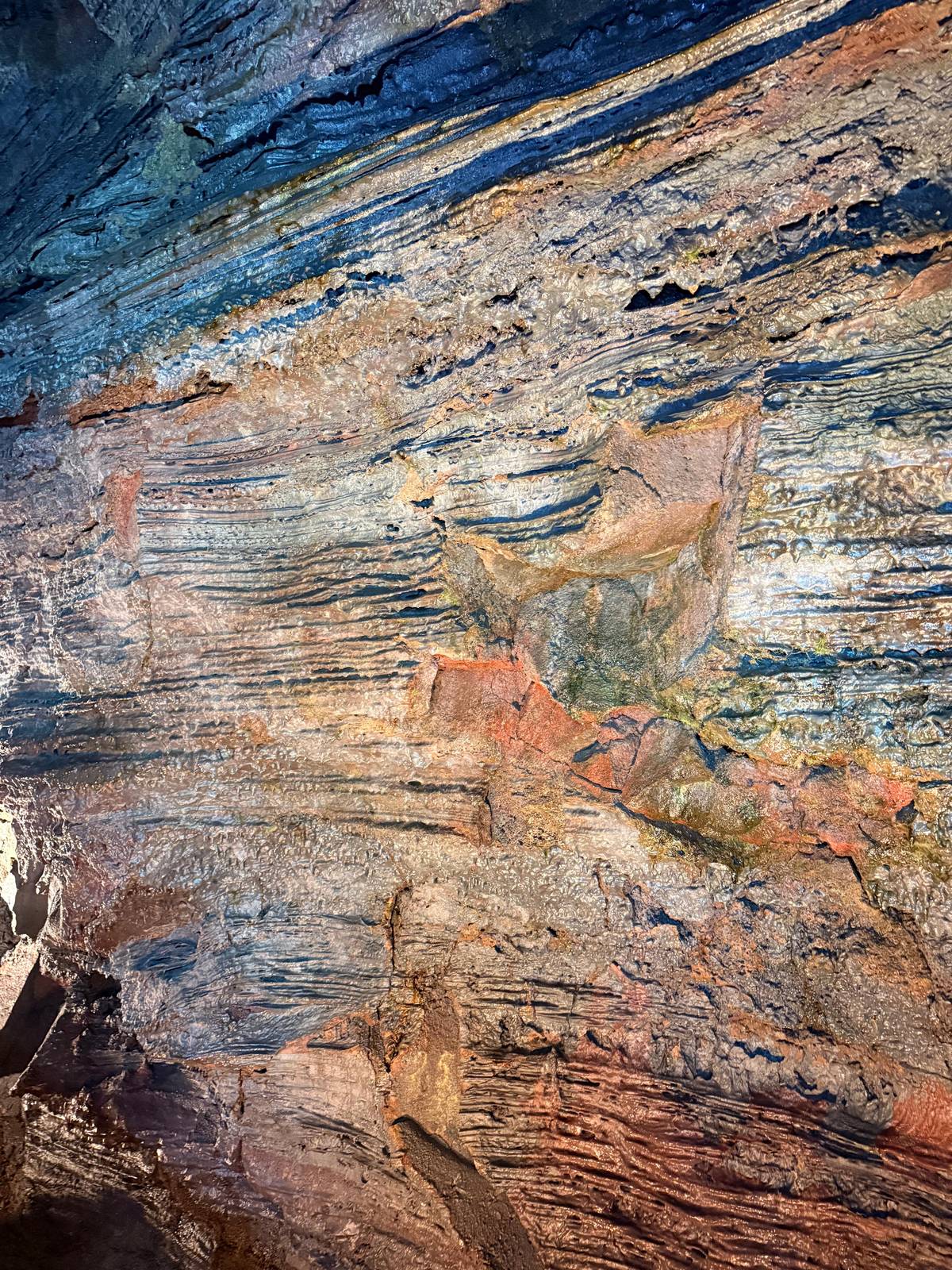
A drained tube is full of clues. The US Geological Survey lists high-lava marks on the walls, generally flat floors and many lava stalactites hanging from the roof as common features of drained tubes.4 The marks are like tide lines: each records a level at which the lava stood for a while. The flat floor is the last layer of lava that set in place as the flow inside slowed and stopped.
Lava stalactites form where molten rock drips from the ceiling before it freezes. In a protected cave they survive in astonishing numbers. The Environment Agency of Iceland describes the stalactites in Árnahellir as too many to count, the longest just over 1 m, with soda straws around 60 cm long and the ceiling almost covered in them.15 Árnahellir was protected as a natural monument in 2002.21
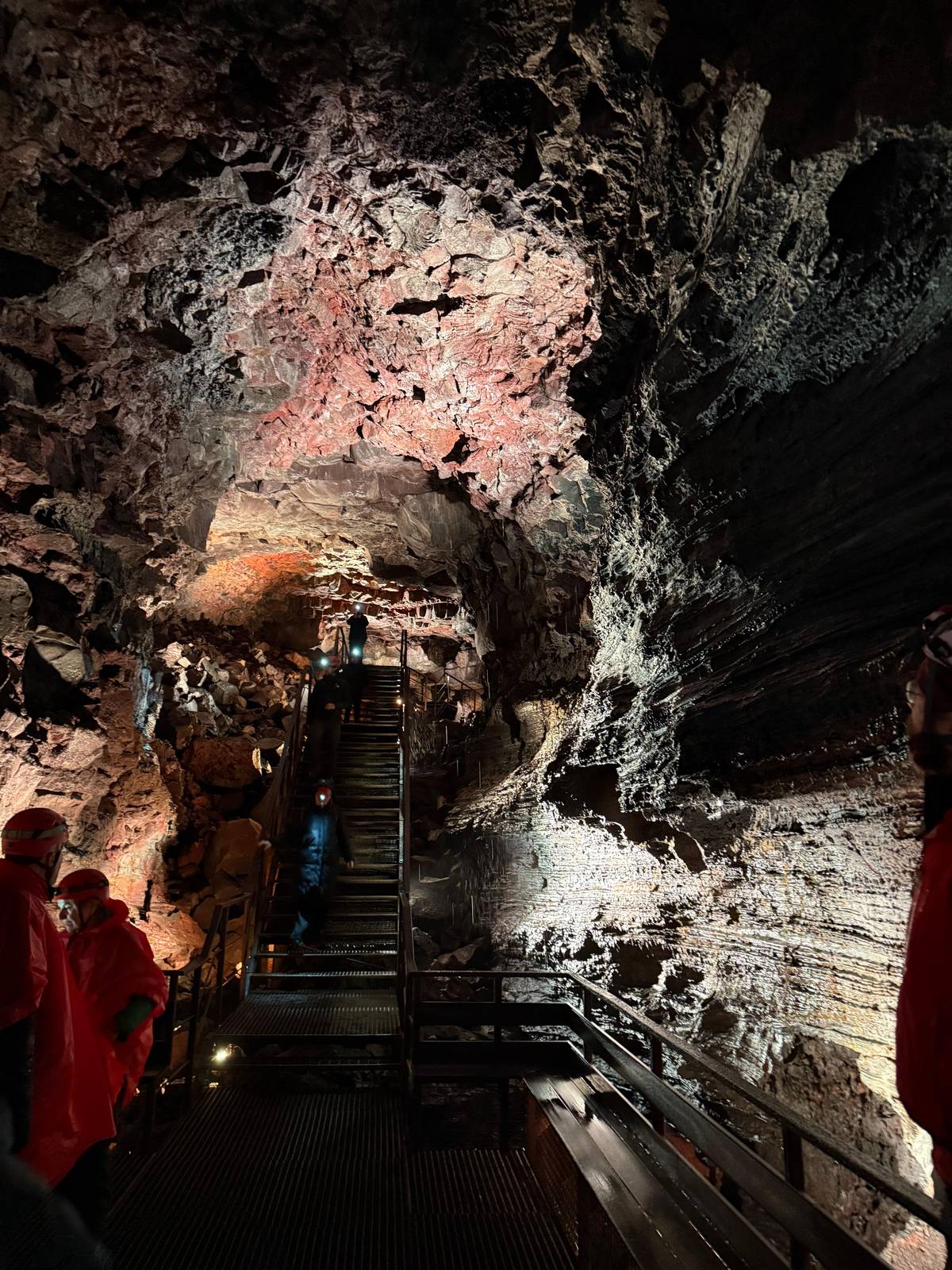
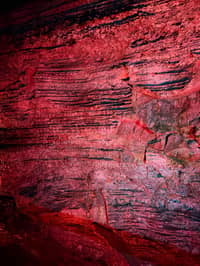
Raufarhólshellir shows the other side of the story. Its operator writes that the tunnel was full of stalactites until the last century, but as more and more people visited in the 1950s they began to disappear, and today almost none are left.22 What remains are the bigger features: the walls streaked with color, the broad floor, and at the far end three smaller tunnels with lava falls, where lava once poured from one level down to another.16
Checklist
Read the rock on your visit
01
Look up
- Skylights where the roof fell in
- Drips of lava frozen on the ceiling
- Colors in the roof under the lamps
02
Look around
- Lines on the walls where lava stood
- Flat floors of set lava
- Blocks fallen from the roof
03
Respect it
- Touch nothing, take nothing
- Stay on the guide's line
- Enjoy the dark when the lights go off
Calculator
Price a lava tube visit
Choose a cave and the number of people
People
Total from$144
each from $72
Check availabilityfree cancellationOur sum: the trip's cheapest GetYourGuide fare multiplied by how many cavers you enter, converted with the ECB's figure for the day. The exact amount shows once you pick a date.
Video
How lava tubes form, and where the lava goes
Nothing from YouTube loads into the page until you press the play button.
Skylights, collapses and winter ice
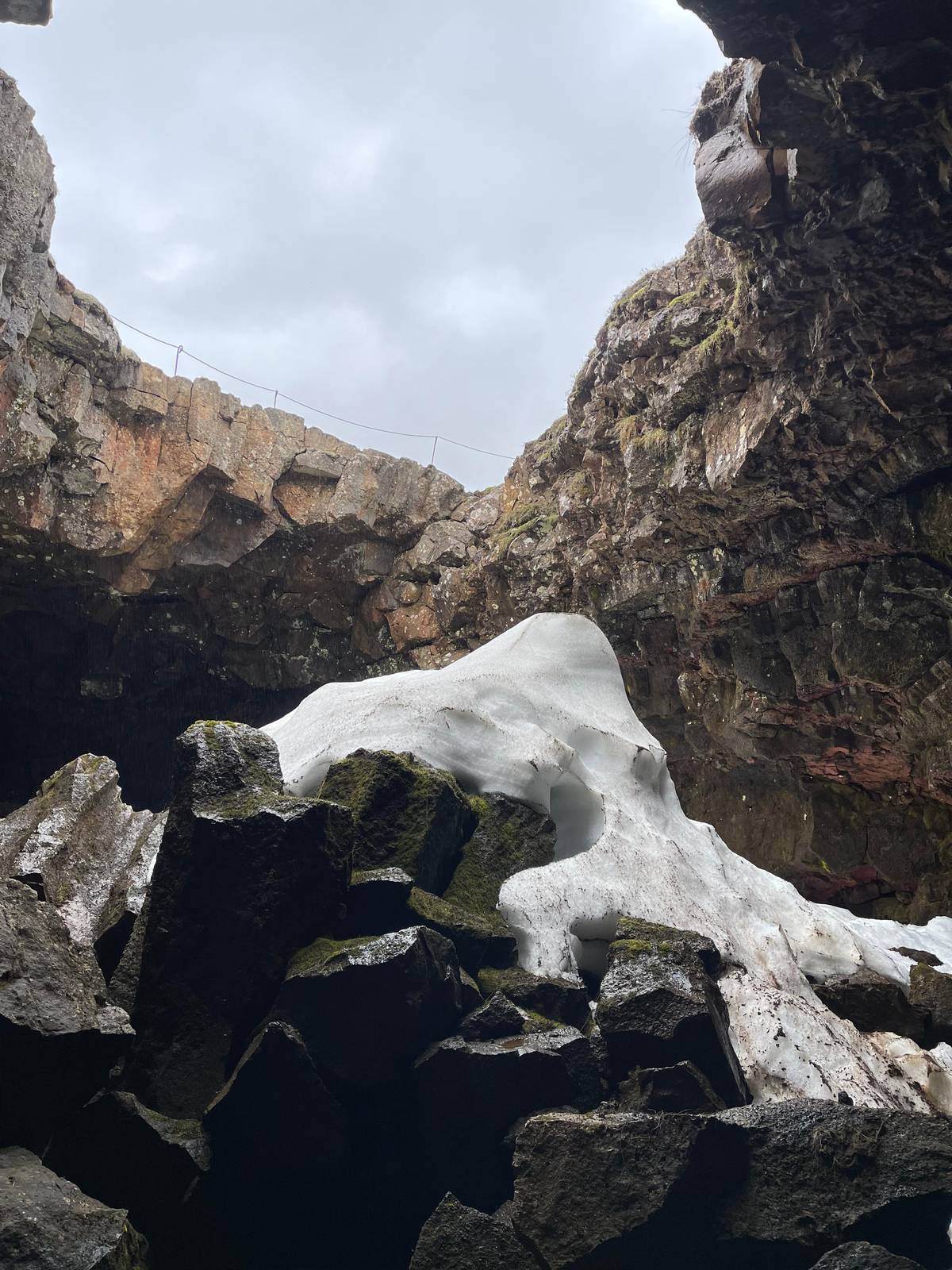
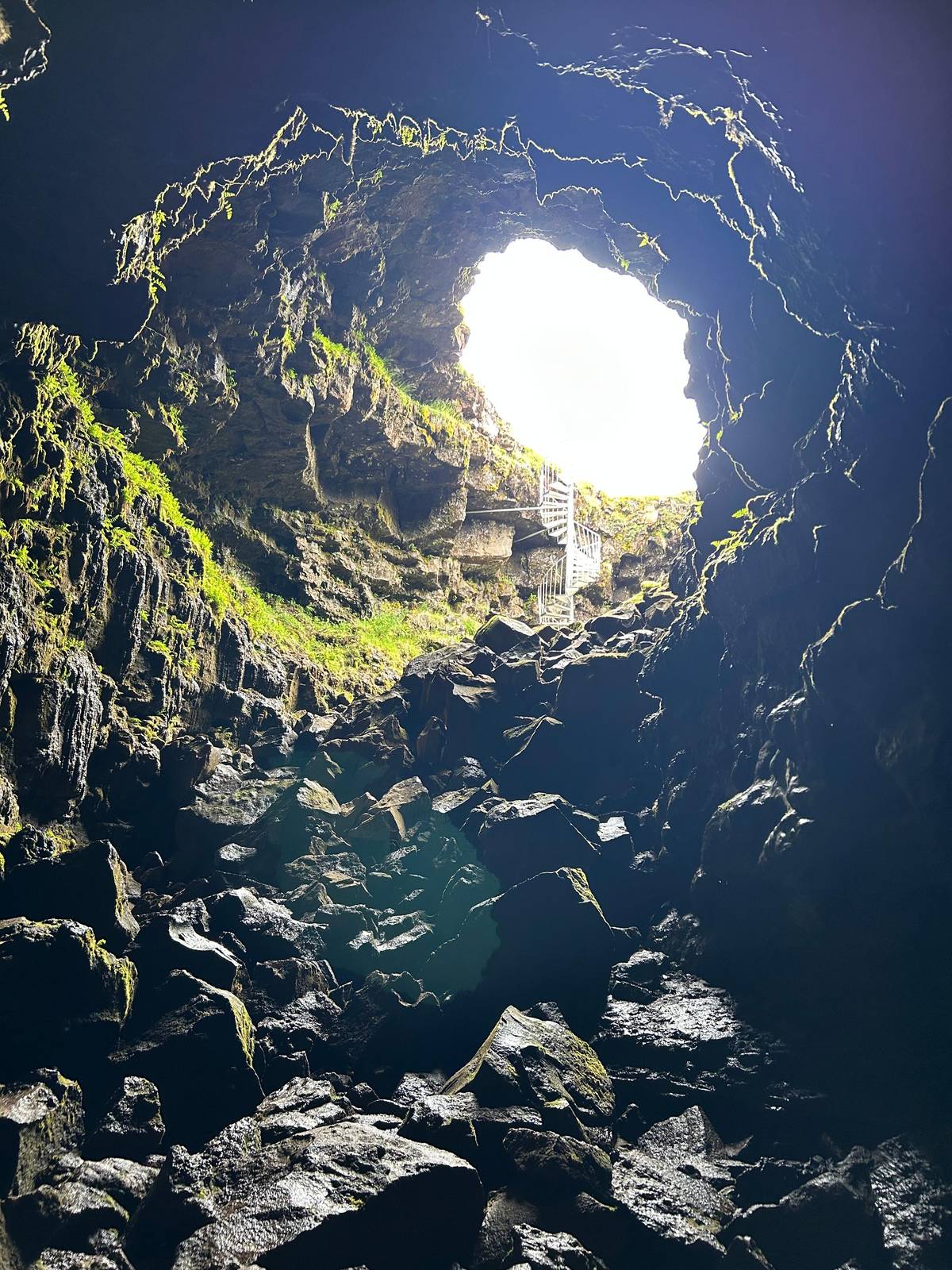
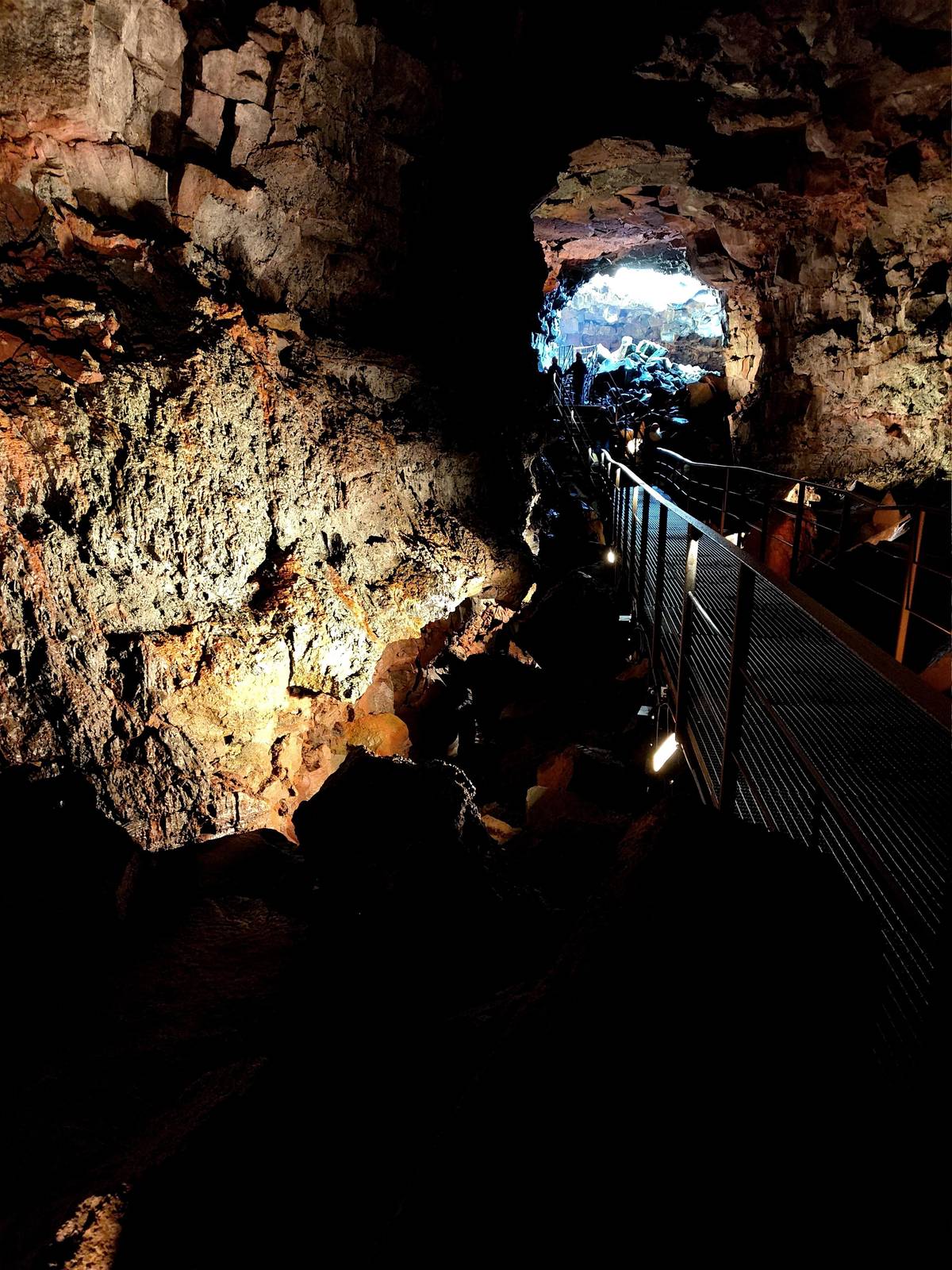
Lava tube roofs are not always solid. The US Geological Survey calls openings in the roof of a tube skylights, and on active flows scientists use them to look down at the lava moving inside.9 Once a tube is old and cold, sections of roof can fall in and leave holes that let daylight down onto the floor. In Raufarhólshellir the ceiling near the entrance has caved in and created three columns of light inside the tunnel.10
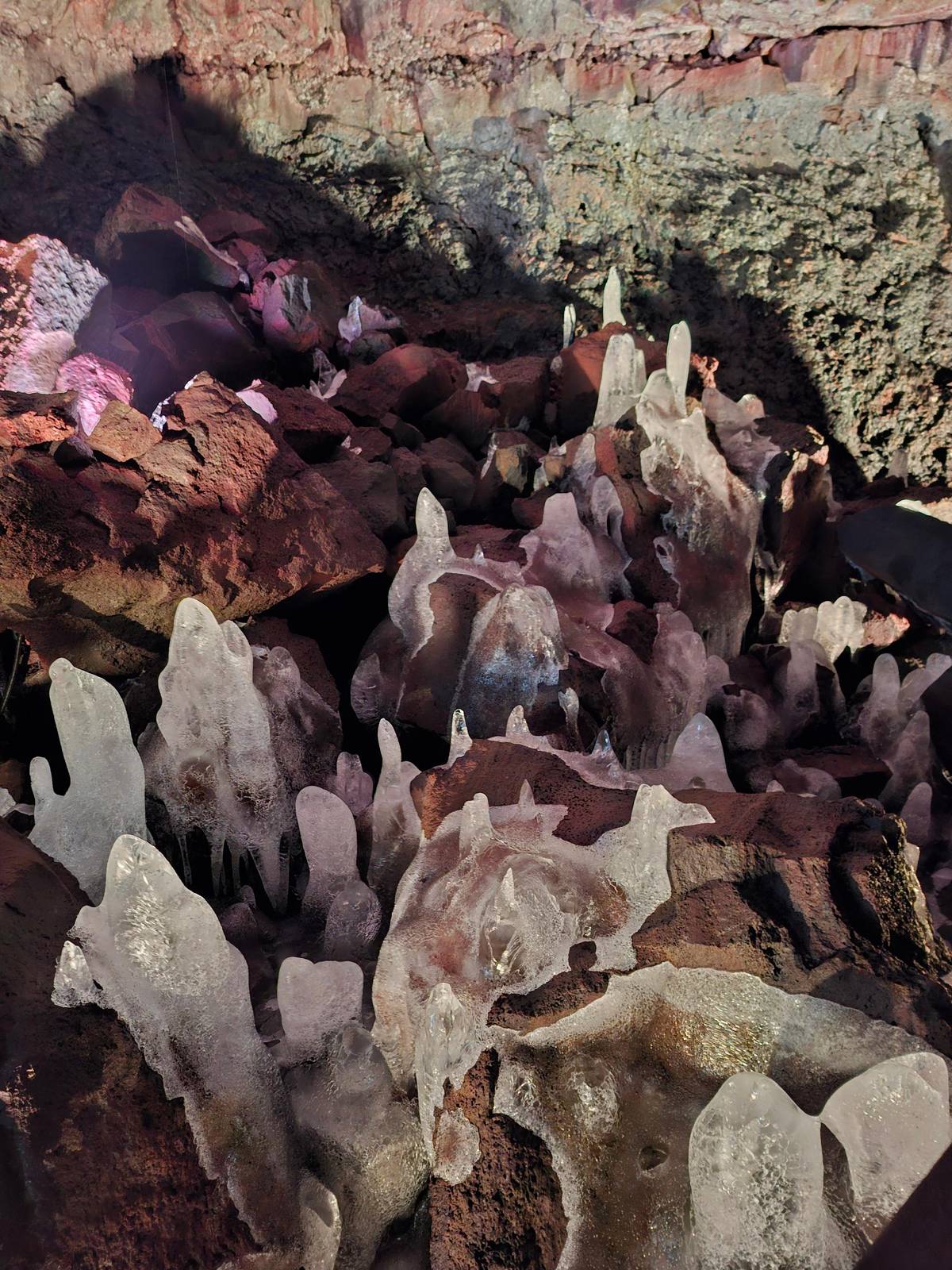
Those openings change the cave with the seasons. Every winter, ice sculptures form inside the entrance of Raufarhólshellir, according to its operator.17 Cold air sinks into the tube, water dripping from the roof freezes, and snow drifts down through the skylights to build white mounds on the black rock. In summer the same spots are green with moss where the light reaches.
Ice can even close a cave. The operator of Víðgelmir writes that ice buildup during the 1960s finally closed off the only access into the cave in 1972; it was re-opened in 1994 and closed the following year with a metal gate.23 The cave's site also mentions seasonal ice inside.24 Lava tubes in a cold climate are not just rock: they are traps for cold air and frozen water too.
Iceland's longest and largest lava tubes
Size is measured in different ways. By length, the Environment Agency of Iceland calls Kalmanshellir, in Hallmundarhraun, the longest known lava cave, a system of approximately 4 km that is protected and closed to traffic without special permission.251326 By volume, the operator of Víðgelmir calls its cave Iceland's largest lava cave, at about 148,000 cubic metres.1924
Hallmundarhraun is a remarkable lava field for caves. The Víðgelmir operator says four of the five largest known caves in Iceland are located there, and that its eruption is usually set at around 900 AD and is estimated to have lasted 1 to 4 years.2728 Walking through one of its caves, you can see how much rock a single eruption moved underground before the flow finally drained away.
Near Reykjavík the tubes are older and somewhat smaller. Raufarhólshellir runs 1360 m in total, with a main tunnel of 900 m, and Visit South Iceland calls it the largest of the many caves in the lava fields of Ölfus.529 Nearby Arnarker, in the Leitarhraun lava field, is about 516 meters long.14 Both are fine examples of what a single eruption can hollow out.
How old these caves are
Every lava tube is exactly as old as the eruption that made it. Raufarhólshellir formed during the Leitahraun eruption about 5200 years ago, according to its operator, east of the Bláfjöll mountains.30 Vatnshellir on Snæfellsnes is older: its operator calls it an 8,000-year-old lava tube shaped by an eruption from the Purkhólar crater family.20
The caves of Hallmundarhraun are much younger. Its eruption is usually dated to around 900 AD, and the operator of Víðgelmir speaks of lava formations 1100 years old inside its cave.2824 That puts the youngest of these caves within the time of human settlement in Iceland, while the oldest were already ancient when the first people arrived.
Age does not decide how a cave looks inside, though. Protection, visitor numbers and the climate do more. A cave can lose its stalactites within decades of careless visits, as Raufarhólshellir did, while an older one closed off by ice or a gate can keep formations intact.2223 When you walk through any of them, the best thing you can do for the next visitor is touch nothing.
Seeing a lava tube for yourself
The easiest place to see all of this is Raufarhólshellir, approximately 30 km from Reykjavík.31 The walk sold on this site lasts about 1 hour, follows a footbridge through a lit section of the tube and starts from $72.32 You will see the skylights near the entrance, the broad main passage and the lava walls, and the guide explains the geological formations as you go.
For the full range of features, compare two caves. Vatnshellir on Snæfellsnes, visited on a 45-minute guided tour down two spiral staircases, shows a narrower, deeper tube.33 Víðgelmir in the west, toured for 1.5 hours on a walkway, shows the scale of the Hallmundarhraun caves.1934 And if you want the lava falls at the end of a tube, the private adventure trip in Raufarhólshellir goes all the way there.18
Whichever cave you choose, look up, look down and look at the walls. The lines left by the lava, the smooth floor, the fallen blocks under a skylight and the frozen drips of rock are a record of a few days or years when molten rock moved through the dark. Once you know what to look for, a lava tube stops being just a tunnel and becomes a story you can read.
Under the lava
Walk into a tunnel the lava made.
Pick a slot, park at the cave on road 39 and step underground with a guide.


You ask,we answer.
What is a lava tube in simple terms?
A tunnel left by flowing lava. Lava flowed under a crust that became a roof, then drained away and left the tube empty.23
Is a lava tunnel the same as a lava tube?
Yes. Both words describe the natural conduit that carried lava beneath the surface of a flow.1
How hot was the lava that made it?
Between 700 and 1,200 °C. That is the range the cave's operator gives for fresh lava.11
What are skylights in a lava cave?
Openings in the roof. In Raufarhólshellir the ceiling has caved in near the entrance and makes three columns of light.910
What are lava stalactites?
Drips of lava frozen on the roof. The US Geological Survey lists them among the common features of drained tubes.4
Sources
The sources for this guide
- 1US Geological SurveyVolcano Hazards Program Glossary - Lava tube↩
- 2The Lava Tunnel (Raufarhóll ehf)The Lava Tunnel - Raufarhólshellir↩
- 3US Geological SurveyVolcano Hazards Program Glossary - Lava tube↩
- 4US Geological SurveyVolcano Hazards Program Glossary - Lava tube↩
- 5The Lava Tunnel (Raufarhóll ehf)The Lava Tunnel - Raufarhólshellir↩
- 6The Lava Tunnel (Raufarhóll ehf)The Lava Tunnel - Raufarhólshellir↩
- 7US Geological SurveyVolcano Watch: How does pahoehoe flow?↩
- 8US Geological SurveyVolcano Watch: How does pahoehoe flow?↩
- 9US Geological SurveyVolcano Watch: How does pahoehoe flow?↩
- 10The Lava Tunnel (Raufarhóll ehf)The Lava Tunnel - Raufarhólshellir↩
- 11The Lava Tunnel (Raufarhóll ehf)Frequently Asked Questions↩
- 12Summit Adventure GuidesVatnshellir Cave Tour↩
- 13Environment Agency of IcelandKalmanshellir↩
- 14Visit South IcelandSouth Iceland West map 2025↩
- 15Environment Agency of IcelandÁrnahellir in Leitahraun↩
- 16The Lava Tunnel (Raufarhóll ehf)The Lava Tunnel - Raufarhólshellir↩
- 17The Lava Tunnel (Raufarhóll ehf)The Lava Tunnel - One of the Longest Lava Tube in Iceland↩
- 18The Lava Tunnel (Raufarhóll ehf)The Lava Falls Adventure Tour↩
- 19The Cave VíðgelmirThe Cave Víðgelmir↩
- 20Summit Adventure GuidesVatnshellir Cave Tour↩
- 21Environment Agency of IcelandÁrnahellir in Leitahraun↩
- 22The Lava Tunnel (Raufarhóll ehf)The Lava Tunnel - Raufarhólshellir↩
- 23The Cave VíðgelmirAbout The Cave Víðgelmir↩
- 24The Cave VíðgelmirThe Cave Víðgelmir↩
- 25Environment Agency of IcelandKalmanshellir↩
- 26Environment Agency of IcelandKalmanshellir↩
- 27The Cave VíðgelmirAbout The Cave Víðgelmir↩
- 28The Cave VíðgelmirAbout The Cave Víðgelmir↩
- 29Visit South IcelandSouth Iceland West map 2025↩
- 30The Lava Tunnel (Raufarhóll ehf)The Lava Tunnel - Raufarhólshellir↩
- 31The Lava Tunnel (Raufarhóll ehf)Location↩
- 32The Lava Tunnel (Raufarhóll ehf)The Lava Tunnel - One of the Longest Lava Tube in Iceland↩
- 33Summit Adventure GuidesVatnshellir Cave Tour↩
- 34The Cave VíðgelmirThe Cave Explorer↩